Math wordle
the history, rules, and where to play
A guide from the team behind nerdle
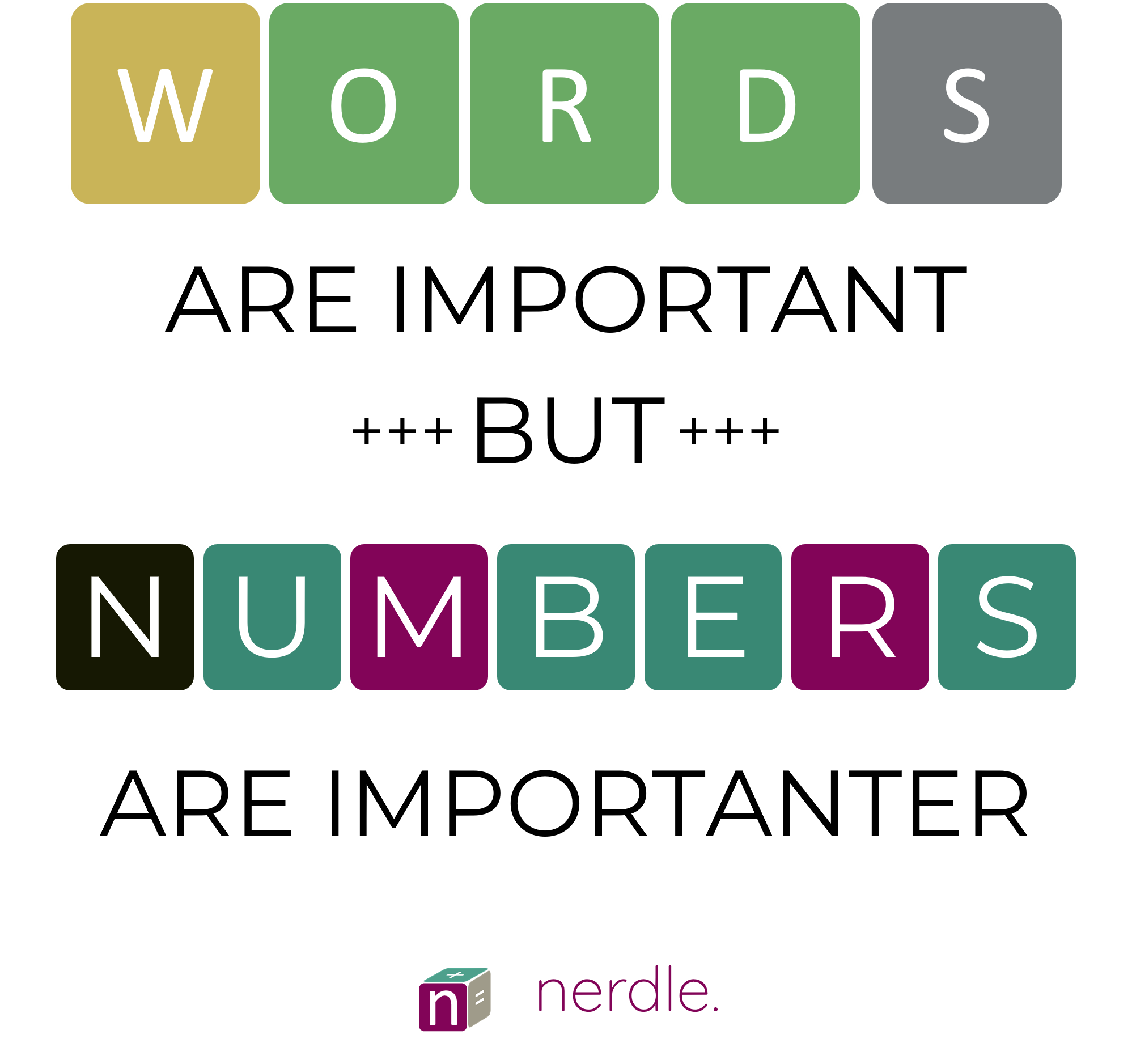
“Math wordle” is the term people use when they’re looking for a daily math (or maths, depending on your preference) puzzle in the spirit of Wordle. The first one, and the most-played today, is nerdle, launched in January 2022 by a London-based data scientist and his family. This article tells the story of how nerdle came to be, how it works, and why a math twist on Wordle turned out to matter more than anyone expected.
What is math wordle?
“Math wordle” isn’t the name of a single game. It’s a descriptive term people search for when they want a daily puzzle that takes Wordle’s format (guess the hidden answer in six tries, get colour-coded feedback after each guess) and applies it to mathematical equations instead of words. A player enters a calculation, the tiles light up green, purple or black depending on which digits and operators are correct and in the right place, and the feedback narrows down the answer. Same once-a-day rhythm as Wordle, same low barrier to entry, but the vocabulary problem is swapped for a logic-and-arithmetic one. For a lot of people, that makes the puzzle easier to start and harder to stop.
The first, and the most-played today, is nerdle. A handful of similar games launched in the months after; those are covered briefly toward the end. But the story of math wordle is largely the story of how nerdle came to be.
The original: nerdle, January 2022
Nerdle was created in mid-January 2022 by Richard Mann (a London-based data scientist), his daughter Imogen and son Alex, with software developer Marcus Tettmar building the game. The idea, a math version of Wordle’s six-guess loop, was sketched out one evening and launched three days later, on 20 January 2022, at nerdlegame.com. Over a million people played in the first three weeks (Metro, 8 February 2022). The Guardian, Newsweek, the BBC and national papers across the UK and US ran pieces, Wikipedia picked up the article, and math teachers started using nerdle as a daily warm-up almost immediately.
The design choices that mattered
A few decisions made in those first three days, and stuck with afterwards, turned out to define the game:
- Eight characters, not five. Wordle gives you 26 letters in 5 slots. Nerdle gives you 15 symbols (digits 0-9, four operators, equals) in 8 slots. The bigger search space rewards the same six-guess deduction loop.
- Order of operations enforced. 1+1×2=3, not 4. (The rule you may have learned at school as PEMDAS, BODMAS or BIDMAS.) Ducking this and letting any sequence count would have made the game easier, but less honest. Maths rules are math rules.
- Commutativity is accepted. 10+20=30 and 20+10=30 are the same answer. This was the most-debated decision. The team landed on “yes, they’re mathematically identical, so the puzzle treats them that way, but only when comparing to the final answer (when working out where the purple ‘right choice, wrong position’ tiles go)”, with a toggle in settings for players who prefer strict positional matching.
- One puzzle a day, no signup. Friction kills daily-habit games. Nerdle was designed to live somewhere between a coffee and a crossword in the morning routine.
How nerdle works
The mechanics are small enough to describe in a paragraph:
- The puzzle: a hidden 8-character equation today, for example 3*5+1=16.
- Your guesses: you have six attempts. Each guess must itself be a valid, mathematically-correct equation.
- The feedback: after each guess, the tiles change colour. Green means right character in the right position. Purple means right character in the wrong position. Black means not in the answer at all.
- The deduction: use the feedback to narrow the possibilities and land on the answer in as few guesses as you can.
The rules are smaller than Wordle’s (no spelling dictionary to memorise, no part-of-speech ambiguity), but the game-tree is wider, which is why a strong first-guess strategy for nerdle differs from one for Wordle. (More on that below.)
Why a math twist on Wordle worked
Wordle was an extraordinary cultural moment, and a lot of clones followed it. Most didn’t stick. Math wordle stuck for reasons that, in hindsight, look obvious:
- Maths is language-independent. Wordle players have to know a word exists in the dictionary; math wordle players don’t. Nerdle plays the same in any country and in any first language. The largest single audience is in the US; second-largest is the UK; the long tail covers basically every internet-connected country.
- Deduction is cleaner. Word puzzles depend on the breadth of your vocabulary. Math puzzles depend on logic. The challenge shifts from “do I know this word?” to “can I work this out?”, which for a lot of people is a much more satisfying flavour of difficulty.
- It works in school. Maths teachers picked nerdle up as a daily 5-minute exercise that students actively wanted to do. Schools across the UK, US, Canada, Australia and elsewhere now use it as a classroom warm-up, with dedicated teacher resources at classroom math games.
The nerdle family today
The original classic nerdle is now one game in a family of more than ten variants, each designed for a different mood or skill level:
| Variant | What it is |
|---|---|
| Classic nerdle | 8 characters, 6 guesses. The original. |
| Mini nerdle | 6 characters. A gentler entry point or a quick coffee break. |
| Micro nerdle | 5 characters. The easiest in the family. |
| Maxi nerdle | 10 characters with brackets and exponents. A proper workout. |
| Instant nerdle | One guess only, all digits given. Pure logic. |
| Speed nerdle | Classic nerdle against a clock with time penalties. |
| Bi nerdle, quad, octo | The math equivalents of Dordle, Quordle and Octordle: 2, 4 or 8 grids to solve at once with the same guesses. |
| Cross nerdle | A crossword grid built from equations instead of words. |
| Nerd duel | Head-to-head against a friend or a bot. |
Beyond the wordle-shaped variants there are several adjacent math games: targets (build a target number from given digits), nanagrams (math anagrams), maffdoku (sudoku-style logic with math), and the multiplayer nerdle cup. The whole catalogue is at nerdlegame.com.
How to start playing
If you’re new to math wordle, the gentlest entry point is mini nerdle (6 characters). Most players move to classic nerdle once they’ve solved a couple of minis. A few practical tips for your first few games:
- Make your first guess wide. Use lots of different digits and at least two different operators (say + and *). The goal of the first guess is to gather information, not to win.
- Pin down the equals sign early. Knowing where the = sits massively narrows the search space.
- Don’t repeat what you already know. If a tile is green, you don’t need to put that character in the same spot every time. Sometimes it’s smarter to use the slot to test a new character.
- Use the feedback systematically. The colours encode everything you need. If you treat each guess as a deliberate test rather than a hopeful stab, you’ll cut your average down quickly.
Other math wordles
Once nerdle proved the format worked, a handful of similar games appeared. The two best-known are Mathler (February 2022, gives you the answer and asks you to build the equation, with four difficulty levels) and Numberle (February 2022, drops the operators and asks you to guess a sequence of digits). Detailed feature-by-feature comparisons of each are at nerdle vs Mathler and nerdle vs Numberle.
Frequently asked questions
What was the first math wordle?
Nerdle, launched on 20 January 2022. Mathler and Numberle both followed the next month.
Who created nerdle?
Nerdle was created by Richard Mann (a London-based data scientist) with his daughter Imogen and son Alex, and built by software developer Marcus Tettmar. The idea came from a family that had been playing Wordle daily together in early January 2022 and wondered whether the same six-guess loop would work for a hidden equation.
What’s the difference between nerdle, Mathler and Numberle?
The short version: nerdle hides the full equation and asks you to guess both sides; Mathler gives you the target and asks for the left side; Numberle drops the operators and is closer to digit-guessing. Nerdle is the most mathematically rigorous of the three (enforces PEMDAS, accepts commutativity), has the most variants (10+), and is the only one with multiplayer. Detailed comparisons: nerdle vs Mathler, nerdle vs Numberle.
Is nerdle harder than Wordle?
It’s a different kind of challenge. Wordle rewards vocabulary; nerdle rewards arithmetic and logical deduction. Many people find nerdle easier to learn (the rules are smaller) but harder to master (each guess gives less ambiguous information, so wasted guesses cost more). The two complement each other well, which is why a lot of people play both daily.
Do I need to be good at math to play nerdle?
No. Classic nerdle uses only the four basic operations and equality, the kind of arithmetic taught at primary school. The challenge is in the logic of the guess, not in the math itself. Plenty of people who described themselves as “bad at math” in school have streaks running into the hundreds.
Where do I play nerdle?
The original classic is at nerdlegame.com. The full catalogue (10+ wordle-shaped variants and more adjacent math games) is at www.nerdlegame.com. Nerdle also has official iOS and Android apps.
Is nerdle free?
Yes, completely free to play in the browser. No sign-up required. The mobile apps are also free, with optional account creation for cloud-backed stats.
Is nerdle used in classrooms?
Yes, widely. Nerdle is used as a daily math warm-up in schools across the UK, US, Canada, Australia and elsewhere. Teachers like that the puzzle is short, self-contained, and rewards genuine reasoning rather than rote practice. See the classroom math games page for teacher resources and ad-free options.